


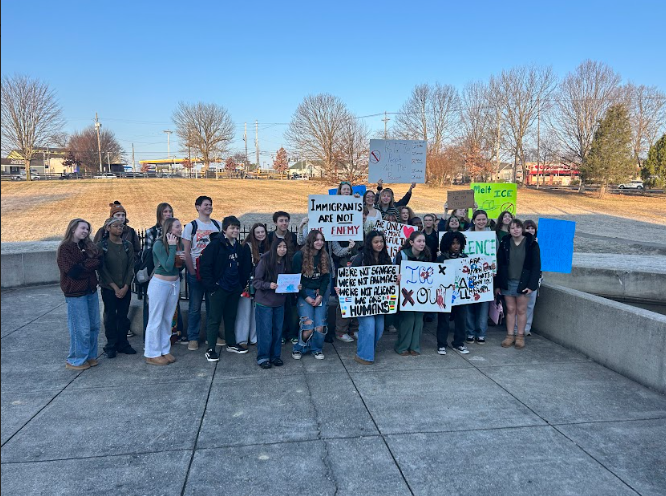
The chilly morning of Friday, February 27, saw Ballard High School’s first walk IN as a form of student protest. These students were not protesting school policies or even district demands, but a nation-wide source of outrage. Increasing numbers of deaths and violence exerted by federal ICE agents (Immigration Customs Enforcement) have led students all over the U.S to use their largest platform, the student body, to demonstrate protests against ICE’s policies or in favor of abolishing the organization itself. Many other JCPS schools held their own protests in late January and early February, including Eastern, Manual, Southern, and Wagner. Ballard’s first attempt at an ICE Walk Out, where students would leave class during the middle of the school day and walk out the south entrance doors, was planned for February 4th. However, this walk out was not approved by administrators, and the doors were locked. Many students left the school campus, an offense that can get you suspended. One junior, Sophia Rodriguez, says “I don’t think that it was a very productive way of protesting and using our voice as children, or young adults. We could call our politicians. We could make it more organized and get people to understand the reason why we are there.” She continues “I think it was just for people to walk out of class just because they wanted to.”
On top of this, other students share the same opinion “I mean, they just walked to McDonald’s because that’s not like a protest. You’re just walking out of school. I feel like they should have stayed,” says Miriam O’Nan. “And if you want to have an actual protest that makes a difference, then you should be serious about the cause and not doing it for the wrong reasons, because it comes off as a joke,” adds on Lizzy Maupin. “From a logistical standpoint, the previous ICE Walk Out was not run by any school official. The dates and the details of it kept changing. People weren’t sure where to go, what to do, and overall, I think the person running it didn’t realize how quickly they would amass a following and therefore panicked afterward,” says the President of Justice Now, the social justice club at Ballard, Luzianna. “I did see some people walk out and some just stand and watch,” says Elijah, a sophomore present at the February 4th walk out. “It disgusts me that some people would use a protest as an excuse to skip school,” he continues.
In contrast, Irene, a student at Manual High School recounts what effect their school’s ICE protest had. “People were brought together through words of others. As I said, many students had prepared speeches to present during the protest and everyone made an effort to really sit in a listen. I think that through this protest, we have been able to be brought together as a group and also find a sense of comfort,” she says. Of course, this protest did happen during the school day, so having administrators approving the protest was crucial. “Administrations had to first approve of this protest so in their own way, they were supportive. They had many staff members keep watch of the students and even support them through kind words and mental support,” says Irene. Maybe, the Ballard protests earlier in the month would have been successful if it was organized in accordance with the school. However, the main student coordinator, sophomore Williamina Mook, says “There are all kinds of rules from both the district and the school that aim to prevent students from losing instructional time and keep everybody safe. For example, the school has to get approval from the district for public media to be allowed on property, and that could take months.” Other challenges were presented, as the controversy of ICE’s tactics might cause tensions within the school. “I met with Dr. Neuss to discuss ways that the protest could be advertised, who could participate, and when it could happen. I was told that because the school and staff members could display no political opinions, I couldn’t post anything on school property, and I couldn’t get a staff sponsor,” says Willamina.
The main form of communication for students interested in protesting was Instagram. Several Ballard specific accounts were created that advocated against ICE, including Ballard Voice For Change and the more mysteriously named “ballardwalk0ut.” The latter account was unclear when it came to instructions, and often changed dates. After administrators locked the south entrance doors, the account posted another Walk Out scheduled for the 11th of February, though many students failed to show up for a second try. In response to this unpreparedness, another account with the username “bhs_peace_in_the_puzzle” was created, posting an info-graphic for an Anti-ICE Walk In. This involved students walking into school, before the first bell rings. This allowed students to participate in a protest without fear of getting suspended for leaving school grounds. The account continued to make posts, instructing students to meet by the bio pond and wear green to represent peace.
On the morning of the protest, students gradually appeared by the bio pond. many people did bring posters this time, and chanted along with the leadership of other students. Eventually, Luzianna, the Justice Now president stood above the crowd and began her speech. She asked the crowd what golden rule they had learned in elementary school, to which everyone replied “Treat others the way you want to be treated!” She continued, sharing examples of the violence performed by ICE agents they were protesting. “And as of today, 48 people that we are aware of are dead because of ICE and it’s corresponding fatality,” she says. A main take away from her speech, Luzianna concludes “I ask you to do one thing at the end of the day, only one. Do not ignore this. Do not watch it happen and hope that somebody else will intervene before you have to. Whether it be sharing info on social media, or calling people from our local government, or donating money. At the end of the day, change can only start with one person at a time.” A statement from Luzianna of what these students were protesting, she says “Immigration Customs Enforcement in itself is not a bad thing. That’s not what we’re saying. We’re saying, they’re no longer enforcing immigration in a legally correct way. Okay? They are allowing people to be racially, ethnically, and linguistically profiled. Hundreds of citizens are being subject to detainments and torture from the hands of this ruthless federal agency that literally has proven, it does not have training.”
High school students can find it difficult for their voice to be heard in a world whose main concerns are what adults have to say about the state of things. “Because if you really think about it, children are the most oppressed group we have. We don’t have standing in the world that we live in, because of our age. And so it only makes the most sense to use the one thing that we have and learn to use it well. We have a voice, we can use it well… we’re the ones that are about to deal with the world that’s being created around us. And so we need to use our voice more than ever. Because who wants to go into a world that we didn’t have a say in?” Says Luzianna. In addition, Willamina says “The goal of the walk-in was not only to raise awareness for the anti-ICE movement, but also to show others that teenagers and children care. We are just as affected, or rather more affected, by what’s happening as adults. We may not have the power to fix the issue, but we can be loud about it.” Addie, a freshman, shares the key to protesting effectively. “Well, first, you need to be peaceful about it, just like we are, but I think that we’re using our voices just the way we can, and people often think that since we’re in high school, we’re too young to have opinion,” she says. Justice Now works to give young people a voice, with Luzianna saying “our big mission is realizing a lot of the adolescent population doesn’t understand, civically, what they can do.”
These well-spoken Ballard students exhibit the effects of showing concern for issues that affect their community. A simple demonstration translates the underlying complexities of being a young adult in the modern world. Pushing their voice forward, high school students face the uncertain levels of acknowledgement aiming into their future. On Friday, a humble group of Ballard students marched into the courtyard to where their voices could be heard bouncing off the walls. Through perseverance and patience, these Ballard students fight with poster and chant to make their voices heard.